
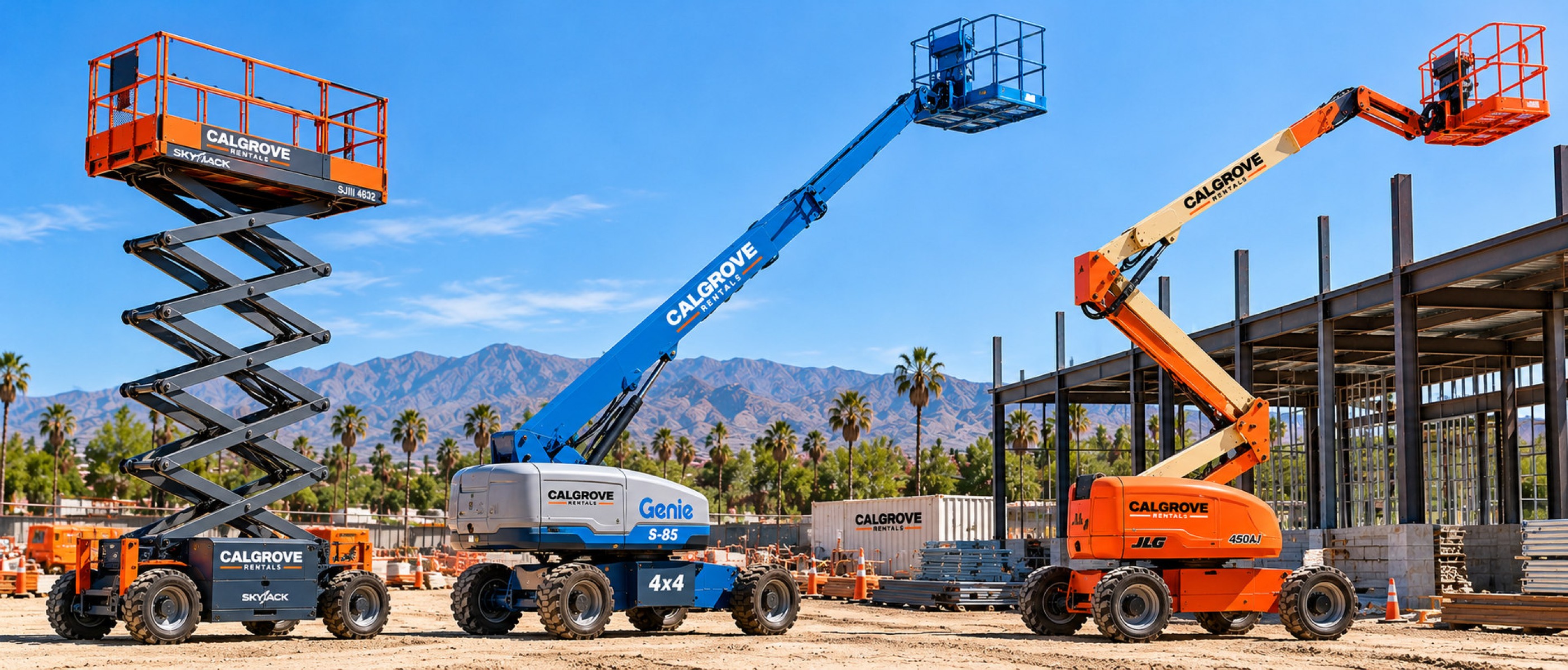
Choosing the Right Aerial Lift for Your Project
Whether you are painting a warehouse ceiling, installing lighting, trimming trees, or working on a building exterior, the right aerial lift makes the job safer and faster. The wrong one can leave you short of your work area, unable to fit through a doorway, or stuck on ground the machine was not built for.
This guide explains the main types of aerial lifts, what each does best, and how to choose the right one for your project.
Start with Three Questions
How high do you need to work? Lifts are usually rated by platform height. A common rule of thumb is that your working height is about 6 feet above the platform height, since that is roughly where your hands can reach.
Do you need to reach up and over something? If there is an obstacle between the machine and your work area, such as a roof edge, machinery, or landscaping, you will need a boom lift rather than a scissor lift.
Where will the lift be used? Indoors on a finished floor, outdoors on pavement, or on dirt, gravel, or uneven ground? The surface determines whether you need an electric or rough-terrain machine.
Scissor Lifts
A scissor lift raises a large platform straight up. It cannot reach out to the side, but it gives you a roomy, stable work area with space for more than one person and their tools and materials.
Electric scissor lifts
Electric scissor lifts are quiet, produce no exhaust, and have non-marking tires, which makes them the go-to choice for indoor work. Narrow models fit through standard doorways and down aisles, while standard-width models give you a bigger platform.
Best for: ceiling work, drywall, painting, electrical and HVAC installs, lighting, and warehouse maintenance.
Typical platform heights: from about 12 feet up to around 40 feet.
Rough-terrain scissor lifts
Rough-terrain scissor lifts have larger tires, more ground clearance, and more power for outdoor jobsites with dirt, gravel, or uneven ground. Many have a larger platform and higher capacity.
Best for: exterior framing, siding, stucco, and commercial construction sites.
Boom Lifts
A boom lift puts a smaller platform, often called a bucket or basket, on the end of an extending arm. Booms trade platform space for reach: they can go higher and farther out than a scissor lift of similar size.
Straight (telescopic) boom lifts
A straight boom extends in a single line. It offers the most horizontal reach and is the best choice when you need to get as high and as far out as possible from where the machine is parked.
Best for: building exteriors, tall structures, signage, and work that is far from the nearest place you can set up the machine.
Articulating (knuckle) boom lifts
An articulating boom has one or more joints, so it can reach up, over, and then down. That lets you work around obstacles such as rooflines, pipes, and equipment.
Best for: jobs with obstructions, working over rooftops, and tight commercial or industrial spaces.
Electric and towable boom lifts
Electric booms are quieter and can be used indoors or in noise-sensitive areas. Towable booms can be pulled behind a properly rated truck, which makes them a practical choice for tree trimming, gutters, and exterior residential work when you want to haul the lift yourself.
Personal and Push-Around Lifts
For light-duty work in tight spaces, a one-person lift may be all you need. Push-around lifts are moved by hand between tasks, while self-propelled personal lifts can drive while elevated. Both are compact, light enough for many finished floors, and fit through standard doorways.
Best for: retail and office maintenance, changing light fixtures, inventory work, and small indoor projects.
What About Lifting Materials?
If you need to raise materials rather than people, a material lift can raise ductwork, drywall, and similar loads into place. For heavier loads on outdoor sites, a reach forklift (telehandler) can lift and place pallets and materials at height and reach. These are material-handling machines, not personnel lifts, so they should not be used to raise workers unless the machine and attachment are specifically rated for it.
Quick Comparison
Straight up, lots of platform space, indoors: electric scissor lift.
Straight up, outdoors on rough ground: rough-terrain scissor lift.
Maximum height and outreach: straight boom lift.
Up and over obstacles: articulating boom lift.
Exterior residential work, towed to the site: towable boom lift.
One person, tight indoor spaces: push-around or self-propelled personal lift.
Raising materials, not people: material lift or reach forklift.
Safety Reminders
Aerial lift operators should be trained on the type of lift they are using. Always inspect the machine before use, set up on firm and level ground within the lift's rated slope, use fall protection where required (a harness and lanyard are required in boom lifts), stay within the platform's rated capacity, and watch for overhead power lines. Never use a lift in high winds beyond the manufacturer's limits.
Frequently Asked Questions
What is the difference between a scissor lift and a boom lift?
A scissor lift goes straight up and has a larger platform. A boom lift has a smaller platform on an arm that can reach up and out, and in the case of an articulating boom, over obstacles.
Can I use a scissor lift outside?
Electric scissor lifts can be used outdoors on firm, level pavement in calm conditions. For dirt, gravel, or uneven ground, choose a rough-terrain scissor lift.
Which lift fits through a standard doorway?
Narrow electric scissor lifts and push-around or personal lifts are designed for doorways and tight aisles. Tell us the width of your narrowest opening, and we will help you pick a lift that fits.
Find the Right Lift for Your Project
Browse our scissor lifts, boom lifts, and reach forklifts, or request a quote. Tell us your working height, what you need to reach over, and the surface you will be working on, and our team will help you choose the right lift.
Comments (0)
Leave a Comment
Your email address will not be published.
Rental Tips & Industry Insights
Stay informed with expert advice, equipment rental tips, safety best practices, and industry insights to help you complete every project with confidence.
Frequently Asked Questions
Ready to Get the Right Equipment?
Tell us what your project needs and our rental specialists will help you find the right equipment, rental plan, and delivery option.